I have a 2 year program to completely self train your own Services Dog. Adjustable depending on condition and dog. Disabled adults and children can benefit from the help of a canine. A letter from a doctor stating that you are disabled and a service dog could assist this condition
Is there anything more comforting than the reassuring touch of a dog? Scientists have discovered that interacting with animals boosts levels of oxytocin, dopamine, and serotonin in our brains, and can even improve our immune system.
These findings prove that dogs bring comfort to the people they interact with, but what exactly is a comfort dog? The term is typically used to describe a type of dog known as a “crisis response” dog. Crisis response dogs are different from therapy dogs and emotional support animals (ESAs), but the distinctions can get confusing, so we’ve broken it down below.
What Are Crisis Response Dogs?
Crisis response dogs are trained to handle stressful, crowded situations so that they can help people remain calm in disasters. Not all therapy dogs have the temperament to be crisis response
These dogs assist people struggling with the aftermath of natural disasters, like hurricanes, fires, floods, epidemics, and tornadoes. Teams of certified crisis response dogs and their handlers also aid individuals affected by man-made disasters. You may have seen footage of canines greeting students returning to campus after a school shooting, or heard about crisis response dogs helping communities recover from acts of terrorism.
Several agencies provide certified crisis response teams to community and government organizations. When a crisis occurs, these agencies reach out to their teams to see who is nearby and available to help.

John Hunt, co-founder of Crisis Response Canines, and Gunther, his 5-year-old Rottweiler, travel across the country in response to mass shootings and disasters. The organization, based in Sicklerville, New Jersey, provides mental first aid for survivors and victims and their loved ones.
“We can’t change what happened,” says Hunt, “but we can certainly prompt a few smiles and conversations from those who have cried their hearts out and not wanted to interact with anyone until now.”
◦ A good crisis response dog is:
• Not afraid of strangers
• Not bothered by crowds
• Outgoing, but calm
• Trained and socialized
• Unbothered by loud noises such as crying or screaming
• Unbothered by children or adults in distress
Crisis Response Dogs vs. Therapy Dogs
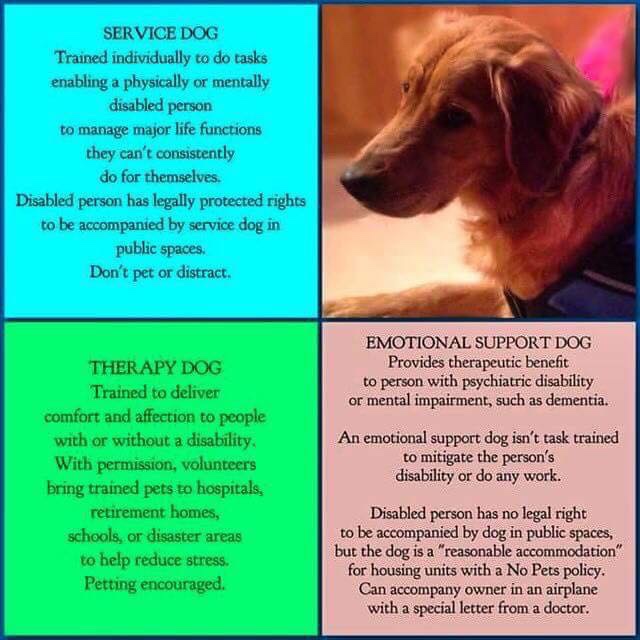
Therapy dogs are privately owned canines. These dogs and their owners volunteer in places like schools, hospitals, and nursing homes. Therapy dogs and crisis dogs are not considered service animals. Owners of therapy and crisis dogs do not benefit from the same legal accommodations as those with specially trained service dogs such as guide dogs. Still, these dogs fill an important role in bringing joy and comfort to the many different people they visit.
As a general rule, therapy dogs should be trained, insured, and licensed by the non-profit that’s offering their services.

Therapy dogs should have a calm temperament, be unfazed by unfamiliar noises and movements, be comfortable being handled, and love people. If you think your canine companion has what it takes to be a therapy dog, check out the AKC’s therapy dog title program.
Crisis Response Dogs vs. Emotional Support Animals
Emotional support animals (ESAs) provide comfort to their owner and only their owner. Unlike service dogs, ESAs are not trained for specific tasks or duties. Under the Americans with Disabilities Act (ADA), owners of service dogs receive special accommodations for their dogs. Owners of ESAs do not. As of 2021, U.S. airlines are no longer required to accommodate ESAs as service dogs; but if the airline chooses, they may allow ESAs to travel as pets in an under-seat carrier or as cargo. Owners are now responsible for any associated fees. See AKC Government Relation’s flyer for more information on the topic.
While certain agencies provide certification and training for crisis response dogs and therapy dogs, an emotional support dog requires only a prescription from a mental health professional.
It is important to note that there are individuals and organizations that sell service animal certification or registration documents online. These documents do not convey any rights under the ADA and the Department of Justice does not recognize them as proof that the dog is a service animal.
Knowing the difference between a crisis response dog, therapy dog, and ESA is important. And if you own a dog with the right temperament, volunteer therapy work provides an excellent opportunity to give back to your community.
Selecting a Puppy
How do you know what breed is right for your family? How do you find a reputable breeder? What questions should you ask a breeder? Download this e-book for guidance on these questions and other important factors to consider when adopting a new family member
Contact your trainer to help you
A variable 2 year program for the disabled: varies based on dog and disability All disabilities except guide dogs for the blind
Links to US Laws Pertaining to Service Dogs
This list is not exhaustive but does give you an idea of the areas laws pertain to so you can do more research.
American-wide
The USA has the ADA (Americans with Disabilities Act) that has overriding laws about Service dogs in the US.
Retailers are allowed to ask 2 questions:1. Is that a service animal?2. What tasks does the dog do to mitigate your disabilities? In order to be considered a SD, a dog must be trained to do tasks that specifically mitigate your disabilities. Here is the act info:https://adata.org/learn-about-ada Here is Service dog related info: https://adata.org/factsheet/service-animalshttps://www.adatitleiii.com/2018/08/service-animals-vs-emotional-support-animals-ferreting-out-the-truth/https://www.ada.gov/regs2010/service_animal_qa.htmlhttps://adata.org/publication/service-animals-booklet There is no certification required federally so do not fall for fake certifications that charge money to “register” your service dog. If you do decide to certify your dog, then the only ones that are valid require you to do a live in-person test WITH your dog. You are tested as a team. Assistance Dogs International has schools that are accredited by them that do offer certification. They are recognized internationally. I have not found an organization will certify owner-trained dogs that they have not been in training with for a period of time.
Airline Carriers Act In addition different laws govern Airlines regarding SD.https://www.transportation.gov/airconsumer/passengers-disabilitiesHousing
Fair Housing Act covers emotional support animals (which are different from service dogs) but your service dog may be covered under this law.https://www.hud.gov/program_offices/fair_housing_equal_opp/fair_housing_act_overviewInternal Revenue Service (taxes)
Fees that can be deducted in the US relating to Service Dogshttps://www.hud.gov/sites/documents/DOC_35703.PDF
State Specific Laws
And each state has different laws that cannot supercede those laws, they can only make them more accessible.In California for example, Service dogs in training are allowed in public places. In some other states they are not. This is the most current state by state comparison of service dogs laws that I have found. https://www.animallaw.info/topic/table-state-assistance-animal-laws
Please Note
These are provided for general interest only. You will need to verify each is current and that the details are correct with a laywer if using them to fight a legal case. SDTI accepts no liability or responsibility for posting them here.
According to the ADA which was created by the federal government, you do not need a fake ID, fake Tags and a vest for your dog to be a service animal. Your doctor determines that you are in need of a service animal because of your disability, after you get that letter you are to register your animal as a #servicedog with your local city or county animal control.
By law no one can ask you for proof of service except for federal agencies since the ADA laws were created for the states of the USA by the federal government. That does create the problem, but that is the law. The only question(s) places of business can ask is; “Is that your service animal and is it for your disability?” You may agree with that or not, but it is what it is.
You are not required to register or certified your Service Animal with FAKE program or company. They are suckering people in paying for these services and people are using it to register their pet as a FAKE service animal.
Click to access service_dog_fee_waiver.pdf
This is a long post but being restricted (me, not my dogs) from walking them, I have been eager to find more challenging games & activities to keep my pups challenged. Here is an article I found great new ideas for anyone looking for new, creative indoor activities with your dog:
“There are many retail sources for snuffle mats, but it’s actually easy to can make one yourself. Here are some instructions for this, thehonestkitchen.com/blog/diy-make-your-dog-or-cat-a-snuffle-matt/
- Snuffle mats. These are another of my favorite relatively new additions to the dog-training world, available in astonishing variety. If you feed dry food, you can feed your dog’s meals in these. I put multiple small treats in mine for Kai to find and he loves the search.
- Slow feeder bowls. These are bowls with deep grooves or other obstacles so your dog has to work to get the food out. I’ve just ordered one for Kai. For a review of some different designs, see “Savor the Flavor,” WDJ November 2020.
- DIY Muffin Tin. Kai’s having fun with this one too – and I can feed his meals in it. Just take a muffin tin, drop treats or smear moist food in the cups, and cover the cups with tennis balls. Then let him work at removing the balls from the cups to access the treats underneath.
COGNITION GAMES
Games that require a lot of mental problem-solving are perhaps even more tiring for dogs than they are for us! Fortunately, they can be just as entertaining as they are exhausting for a convalescing dog.
If your dog becomes adept at learning colors, shapes, and object discrimination, you may at some point be able to tell you to select the yellow square or the blue ball from a stack of toys. Deanne Davenport is shown here working with Kai to recognize colors at “Cognition Academy” at Miller’s training center in Maryland. Photo taken pre-pandemic and well before Kai’s injury.
- Color discrimination. Yes, you can teach your dog to recognize colors! Then you can ask him to touch a target of a specified color or fetch a ball of a certain color. Dogs see blue and yellow well, so those are the best colors to work with. It’s thought that dogs see other colors as shades of brown, so you could add one more color (and perhaps black and white).
Start by asking your dog to “Wait,” then present one color (I use colored paper plates). If I was teaching a dog to identify blue, I’d say “Blue,” pause, and then say “Touch” (you want “Touch” to be the cue, not “Blue”).
Next, repeat the same process with yellow.
After several repetitions with each color individually, present both colors and ask him to touch one color. (If he heads for the wrong one just whisk it away, reset, and try again.) At first, position the one you’re going to ask for a little closer to your dog. As he is consistently successful at touching the color named, gradually present the two choices more evenly, until he can select the correct color without the offset assistance.
- Shape discrimination. Teach your dog the word for a few basic shapes. The process is the same as with colors. Present one shape first and name it, then present the other, and then the two shapes together, offset at first.
- Object discrimination. Dogs can also learn the word for some basic items, whether it’s a variety of toys (such as ball, disk, bone, or toy alligator). Kai is pretty good at indicating named objects, such as Ball, Roomba, and Stuffy.
No surprise – the process is the same as above. Present one object and name it, then present the next object, and then the two objects together, offset at first.
For more detail on how to teach these cognitive discrimination games, see “Are Canines Cognitive?” WDJ October 2017.
This dog is learning to copy an active behavior (walking around the cone). Because Kai needs to be as inactive as possible, he’s been learning to copy more stationary behaviors , such as “cross your paws”, nodding “yes” and shaking his head “no”
- Imitation. Teach your dog to “do what you do,” imitating movements such as a bow, a yawn, or a comically vigorous “no” nodding of the head. This is a much more complex cognitive challenge – and more brain-tiring than the discrimination exercises.
Here’s a simplified description of how to train this: It’s easiest if you start with a behavior he knows well on verbal cue. Let’s use “spin” as an example. Have your dog wait in his starting position while you demonstrate the human version of a “spin.” Return to your start position, say “Copy!” Pause for a second or two, then give his cue for the “spin” behavior. Repeat up to three times in a row.
Then, repeat the process with a second behavior – say, backing up. Ask him to wait in a starting position, back up yourself, say “Copy!” pause, and then give his cue for “back up.” Repeat this a few times.
Then, repeat the process with a third behavior.
Finally, start randomly alternating these until he starts to offer the correct behavior on the “Copy” cue without needing the verbal cue for that behavior.
Note: If you continue with the same behavior too many times in a row, he will just think “Copy” is a new cue for the behavior you’re demonstrating, rather than a new training concept.
For a more complete description of the imitation protocol, see “Train Your Dog Using Imitation,” WDJ October 2013.
- Counting. This is definitely an upper-level cognition game. A protocol for teaching “quantity recognition” was developed by noted trainer Ken Ramirez, the former executive vice president of animal care and training at the Shedd Aquarium in Chicago, now the executive vice president and chief training officer with Karen Pryor Clicker Training. Here’s a very simplified explanation of Ramirez’s protocol:
The dog’s “answers” of one through five are made available to him in the form of small boards that are sprinkled with one, two, three, four, or five black dots. The “question” is put to the dog in the form of a tray, upon which are arranged one, two, three, four, or five items. The dog is shown the tray, laden with objects, and then asked “How many?” The dog indicates the number of items he saw on the tray touching the board with the same number of dots.
To see a couple of videos of Ramirez discussing this brain-game, see kenramireztraining.com/media/.
TRAINING GAMES
Zeus, a shelter dog from Ohio, is learning how to do a “chin rest” in one of Pat Miller’s Behavior Modification Academies. A dog’s understanding of this behavior is very helpful for low-stress, low- or no-restraint veterinary examinations.
You can also enrich your dog’s restricted environment by training him to do a variety of stationary behaviors, such as:
• Paw Targeting: Teach him to touch his paw to a designated target.
• Nose Targeting: Teach him to touch his nose to a designated target. (When he knows paw and/or nose targeting you can teach him more low-activity fun stuff like pushing a talking button or light button, and playing a kiddie piano.)
• Say “Yes” and “No” – Teach him to nod his head up and down and to shake his head left and right.
• Wait: Teach him to not eat a treat within reach until you give him permission.
• Balance a Treat on Your Nose: This is easiest if he already knows “wait.” Then start with the treat at the bridge of his nose (between his eyes). As he grows more advanced at holding still, you can gradually move the treat toward the tip of his nose.
This is a great opportunity to work on useful cooperative-care procedures such as the Bucket Game (featured in “Care to Cooperate,” WDJ February 2021) or a “chin rest,” where he’d rest his chin on a rolled-up towel while you perform an exam or husbandry procedures. Both a chin rest and the Bucket Game are performed with the mutual understanding that you will stop the procedure if he looks away from the bucket or lifts his chin off the towel. He learns that you will not proceed until he gives the “okay to continue” signal of looking at the bucket or resting his chin again.
JUST WALK
Though Kai is not supposed to exercise, he does have to walk to go to the bathroom several times a day. So I figure that we might as well make use of these bathroom breaks as best we can, with a calm, quiet, slow on-leash walk.
Accustomed to ripping through the woods and across the fields at top speed when we go hiking, Kai is tolerating these short walks and I am loving them. It amazes me that he likes to stand like a statue and just look at and smell our surroundings, for minutes at a time, only his nostrils moving as he picks up scent and watches for movement. He has always enjoyed scent work, and it’s fun to watch him detect and follow a scent. Sometimes I go outside before I take him out and “salt” our walking path with treats for him to find.
REWARDING TIME
Whatever you do to pass this quiet time with your convalescing dog, rather than agonizing over the pain of managing her restricted activity, try to breathe deeply and enjoy doing enrichment activities with your dog. You might find out later that this was some of the most rewarding time you’ve spent together. “I
_______________<<<<<<<<>>>>>>_____________
This is an excellent article to help us keep our dogs focused and to set them up to
succeed.
Owner training allows handlers to choose some non-traditional breeds or higher energy individual dogs that match their active lifestyle. Some people end up with dogs that have more energy than they bargained for or they inadvertently ramp the dogs up by how they interact with the dog (what they reinforce without knowing it like jumping up on their arrival or excited behavior in general). While it is important that these dogs get enough appropriate exercise, it is also important that these dogs be taught how to relax. The relaxation protocol created by Dr. Karen Overall is one tool that they can use to help teach a dog to calm themselves.
The relaxation protocol is an incremental way to teach a dog to calm himself in the face of distractions. It lays out a training process so the handler can add distractions in small enough bits that the dog can succeed. There are many layers to this protocol and they are laid out in detail for handlers to follow. A bit of creativity will be needed to adapt some of the distractions for people with balance or mobility challenges. A side effect of the protocol is building a reliable stay behavior which is ideal for service dogs. You can combine the protocol with a mat to more easily generalize it to different locations.
Here is a link to the text-based protocol.
Here is a link to audio clips that you can listen to while training.
If your service dog in training has a short attention span is antsy or has trouble focusing, it is worth trying the protocol. It is a great foundation to start training relaxing with a puppy too!
 Pam’s Fun with Fido ......Dog Training